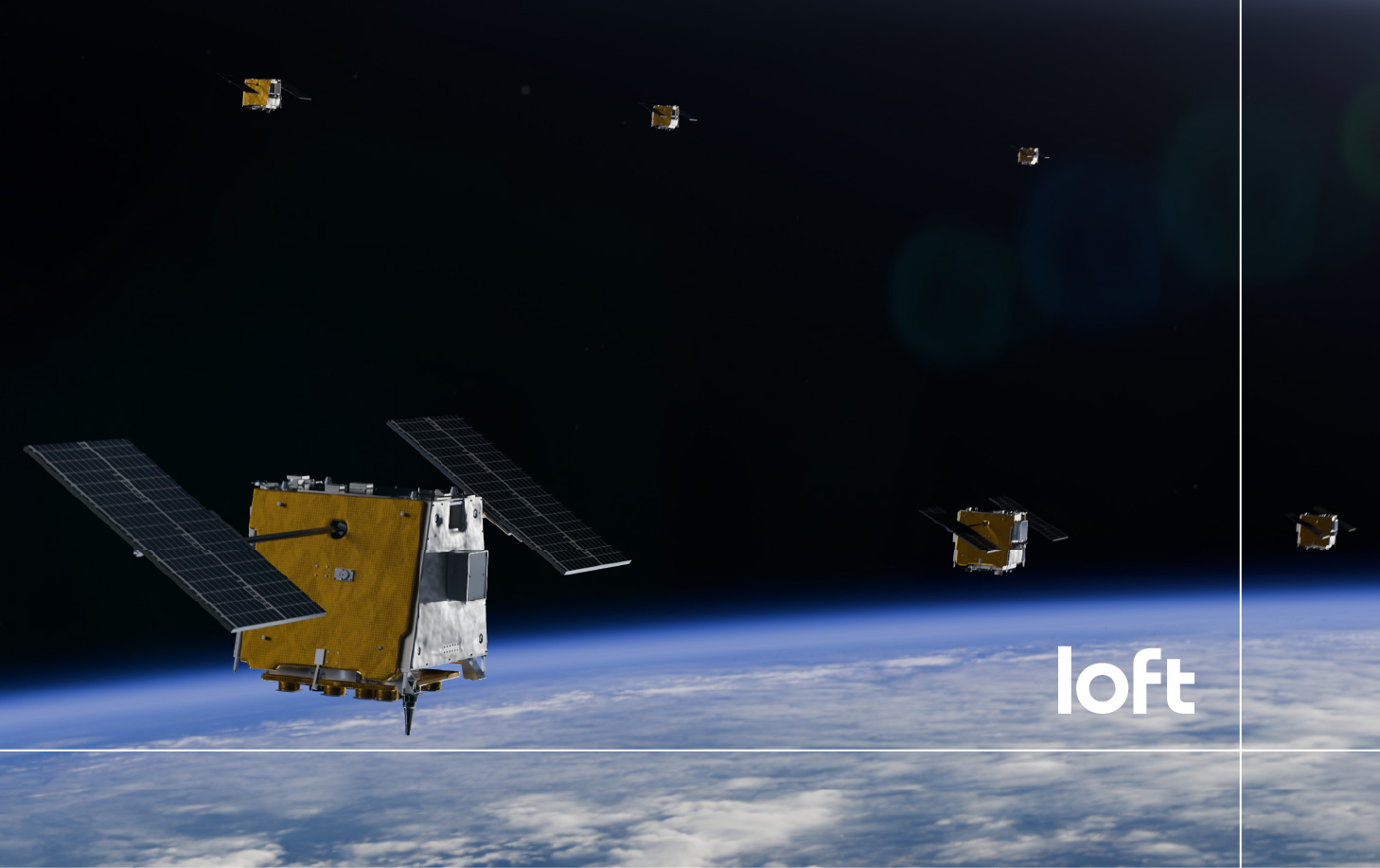
First satellite of a fifty-satellite AI constellation is in orbit, running Mistral AI models on NVIDIA Jetson AGX Orin; Loft Orbital is evaluating NVIDIA Space-1 and IGX Thor for the satellites that follow
Orbitworks and Loft Orbital today announced that the first satellite of their fifty-satellite artificial intelligence constellation, launched on October 1, 2026 aboard a SpaceX rideshare mission, carries two NVIDIA Jetson AGX Orin modules to run AI models, including Mistral AI’s Ministral 3, directly onboard. It is the first satellite of the $1 billion program announced in Paris by Emmanuel Macron on September 9, and the first built by Orbitworks at its facility in Abu Dhabi. Every satellite in the constellation will fly NVIDIA accelerated computing.
The satellites analyze what they observe while still in orbit and transmit the event rather than the raw imagery. A user receives an alert within seconds instead of a file hours later. First applications include maritime domain awareness, wildfire and disaster response, and the security of ports and critical infrastructure. Users will choose applications from several providers through an AI app store and run them on shared satellites, so one constellation serves many programs at once.
Onboard, the NVIDIA Jetson edge AI modules run computer vision and vision-language models built on NVIDIA CUDA 12.6, TensorRT and JetPack 6.2.1. The GPU corrects each image against known reference points on the ground, so every detection leaves the satellite pinned to its precise position on the map. Data stored onboard is encrypted with post-quantum protection, using ML-KEM-1024, the highest security level in the new NIST standard.
Models already loaded on the first satellite of the new constellation include Mistral’s Ministral 3, in its 3B and 8B versions, which summarize acquisition data and answers operator queries in orbit. It runs alongside nearly twenty models for ship detection, cloud masking, wildfire, burn scar and flood mapping, image super-resolution, and scene description from NASA’s Jet Propulsion Laboratory, Google, IBM, Meta, Microsoft, and Hugging Face.
Loft Orbital has run AI at the edge in space since March 2024, when it launched YAM-6, its first satellite equipped with an NVIDIA GPU, and has flown more than twenty AI missions since. Earlier this year, NASA’s Jet Propulsion Laboratory and Loft Orbital demonstrated a world first on the Loft satellite YAM-9, using a NVIDIA Jetson AGX Orin. The satellite runs a vision-language model onboard, allowing the satellite to understand what it sees and tasked in plain language. The results are published in a joint paper [arXiv:2606.18271].
“NVIDIA compute sits at the center of how we design our satellites,” says Paul Lasserre, General Manager, AI for Space at Loft Orbital. “It is the common denominator across every satellite type and every sensor we fly, optical, thermal or radar, so that what a satellite sees becomes an alert on the ground in real time, and the constellation learns to run itself.”
The $1 billion program extends this first-of-its-kind AI constellation to fifty satellites. That scale brings Earth observation into a new paradigm. AI onboard enables real-time applications and autonomous operations, and the high revisit that comes with a dense constellation means an intelligent spacecraft is never far from wherever an event of interest takes place.
The program was announced and signed at the International Space Summit in Paris by Marlan Space and Loft Orbital. Marlan Space is a UAE-based investor and operator in space technology and a subsidiary of IHC. The constellation is built to serve government users from France, Europe and the UAE, as well as global commercial and sovereign customers. The satellite infrastructure, held in a dedicated French company, combines Emirati ambition, capital and manufacturing capabilities with European supply chain expertise and space heritage.
The satellites are produced by Orbitworks at its purpose-built facility in Abu Dhabi, the largest satellite constellation production and operations facility in the Middle-East.
For the next generation of satellites of this constellation, Loft Orbital is evaluating the NVIDIA Space-1 Vera Rubin compute module as well as the NVIDIA IGX Thor for real-time AI reasoning.