HubKit turns payload integration from guesswork into a simple, hands-on experience. Loft’s mission integration testbed allows customers to debug software against real interfaces long before satellite integration. Engineers stay in control, timelines stay predictable, and “will it work” becomes “it’s already proven.”
What is HubKit?
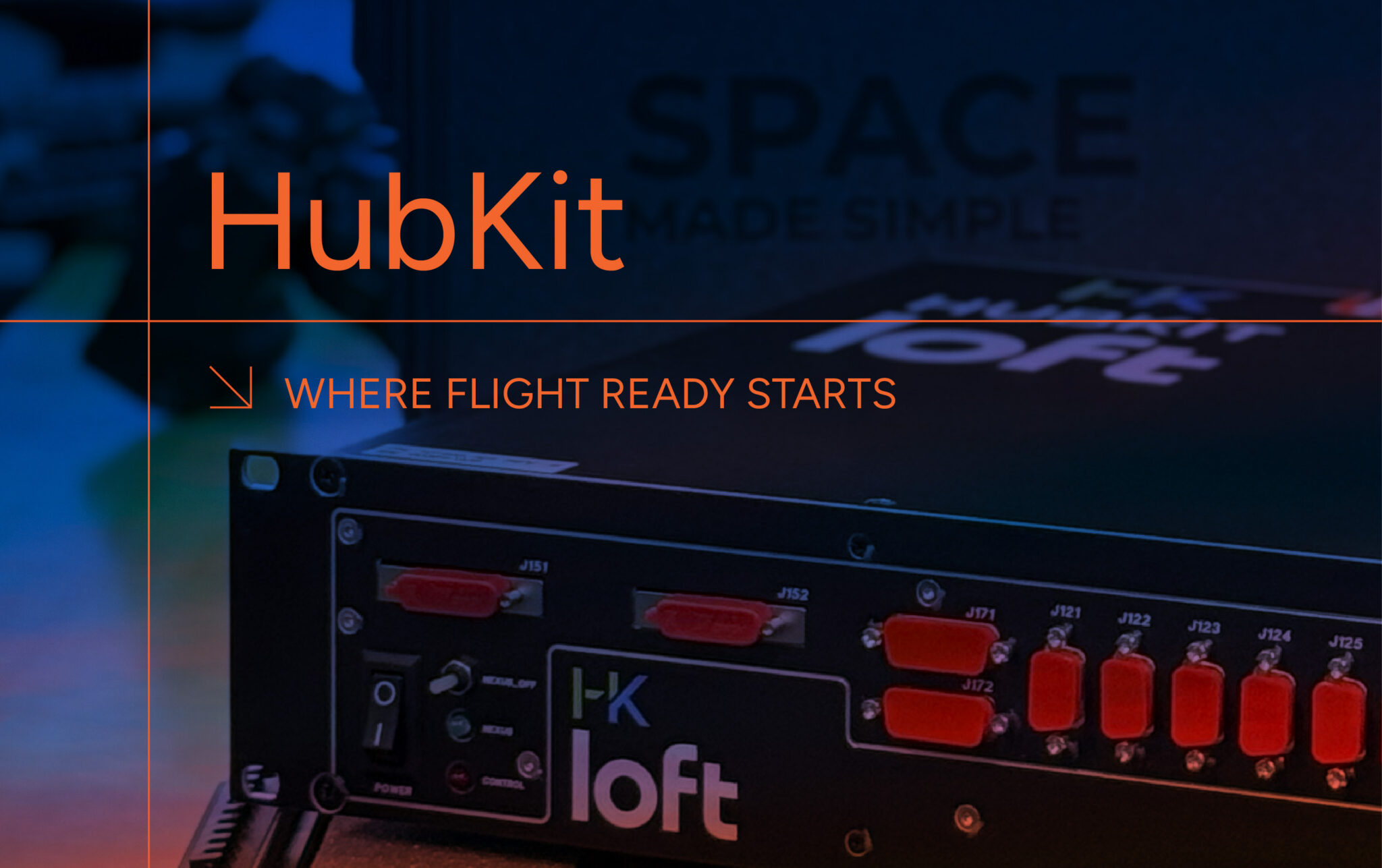
HubKit is Loft’s flight representative mission integration testbed for customers looking to fly their payloads in space. It provides a bench top version of the Hub interface so software teams can connect their payloads to the same electrical and software environment it will experience on orbit. Simply plug in, power up, and almost immediately start exercising commands, data flows, and test cases against Loft’s standardized infrastructure.
Instead of having to revise and debug the software while the payload is at Loft’s integration and test facility, HubKit allows customers to uncover and resolve issues where they work best, streamlining integration schedules.
Designed for reducing schedule and technical risk
- Flight representative interfaces and software
Connect through the same data and TMTC interfaces that exist on Loft’s Hub universal payload adapter, backed by flight representative firmware and software. Engineers validate timing, message formats, and behavior against the abstraction layer that will sit between the payload and the bus. - Self service diagnostics and procedures
A clear set of procedures, dashboards, and logs lets teams run checks, gather evidence, and isolate problems without waiting on a call. Engineers can replay tests, capture logs for Loft support, and iterate quickly, turning long email chains into short, precise fixes. - Shared single source of truth with Loft
HubKit is deeply integrated with Loft’s infrastructure and processes. When procedures are updated, Loft sees the same artifacts and can run them during integration. Both teams debug against the same scripts, the same expectations, and the same pass/fail criteria. - Speed to orbit without extra risk
By proving integration readiness up front, HubKit shortens the critical path without cutting corners. Tight schedules become achievable because interface surprises are handled early, not discovered on a satellite that is already on a vibration table.
Transforming integration workflows
With HubKit, the first time the payload connects to Loft’s Hub is not on a spacecraft. On day one when the HubKit is received, the team can send initial commands and watch telemetry populate, seeing in real time how Loft’s abstraction layer presents power, timing, and data.
As the program matures, engineers can script more complex scenarios, simulating lost links and recoveries, stress data rates, and edge cases that are difficult to recreate on a full satellite stack. When a test fails, customers have full visibility into logs and procedures to easily pinpoint whether the issue is with the payload, in the interface definition, or in the mission-specific software.
By the time the payload is ready to ship to Loft’s integration and test facility, it already knows Loft’s interfaces. Loft uses the same tests to integrate the payload with the Hub, so there are fewer surprises, fewer last-minute debug sessions, and a much smoother path to mission success.
Where flight ready starts
HubKit is one of the many levers unique to Loft that allows customers to achieve their mission outcomes faster. When ready, engineers can connect their payloads to HubKit so that when it reaches orbit, customers can predict how the payload will behave. This is where flight ready starts, with simple interfaces, reliable integration schedules, and reduced technical risk.