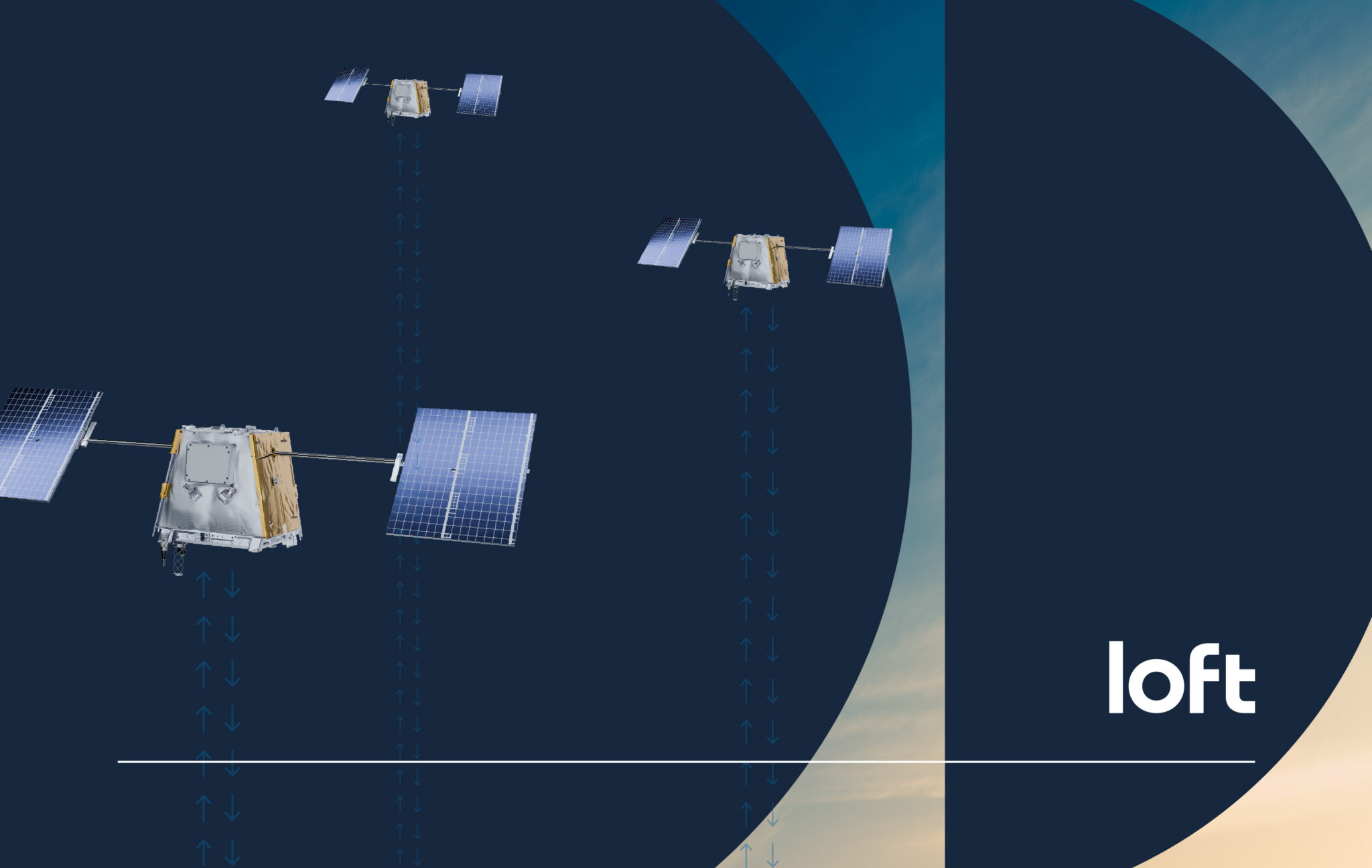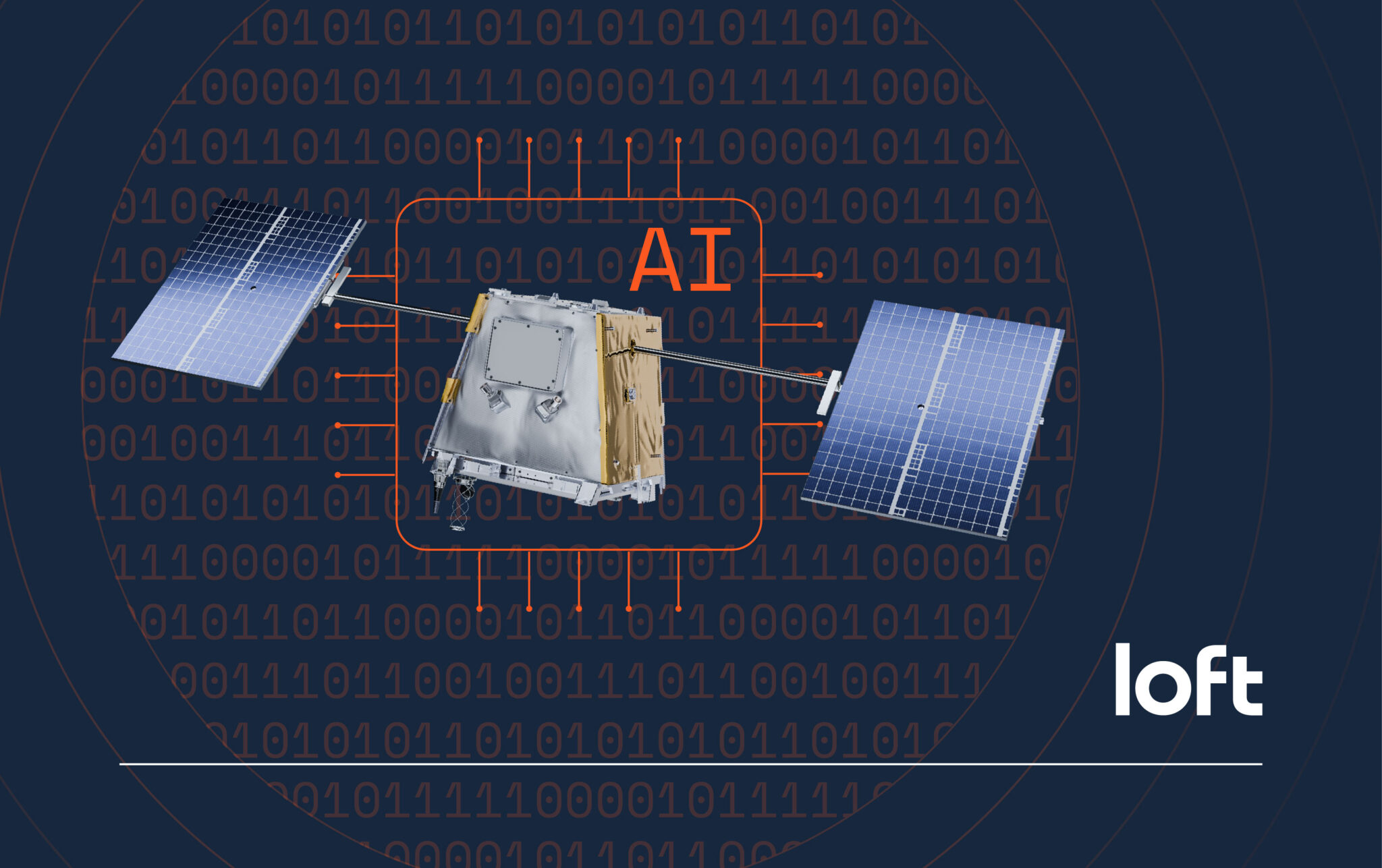
In June 2021, Loft launched its first satellite to space, the first step in our mission to make space fast, simple, and reliable. We were setting out to test an idea to make space capabilities as easy as deploying a new application on the cloud. Just five years later, we are now deploying full constellations and AI agents, including the first reported vision language model for near real-time Earth observation analysis. What began as a bold idea is now an on-orbit AI platform, built by an international company, with a heritage of missions that would have seemed ambitious at the outset.
June 2021: YAM-3 and the Development of a New Model
Loft was founded to challenge the traditional, slow-paced space industry in a new way. The goal was to eliminate the complexity of space missions by building hardware and software abstraction layers that allow customers to focus on their core mission. The YAM-3 program was the first to prove that mission, but it hasn’t just been a proof of concept. It’s a commercial rideshare mission flying three customer payloads and hosting two on-orbit AI software missions, and it continues to operate today. Not only was this Loft’s first satellite in space, it still serves as proof that Loft’s hardware and software stack can reduce schedule and technical risk so customers can focus on their objectives.

Expanding Globally: The Diverse Team That Built the Platform
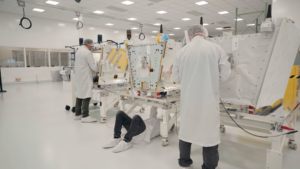
As our launch manifest grew with new flight programs, so did Loft’s facilities and international footprint. Soon after the company was founded, Loft built its European headquarters in Toulouse, France, a hub of aerospace innovation and talent. In 2024, we expanded our production capabilities with a new 13,000 square foot facility in Golden, Colorado, featuring ISO-8 cleanrooms and test equipment for full in-house integration and testing. Today, we are building out a new facility in Arvada, Colorado to support US government customers and their classified missions. Loft has also developed a joint venture in Abu Dhabi to bring new space capabilities to the region. Building a global team has been core to our company culture and key growth driver of Loft’s diverse customer base.
A New Kind of Mission: Deploying AI and Software Apps with YAM-6
If YAM-3 proved the satellite rideshare model, YAM-6 pushed the boundary of what’s possible by creating a novel platform for deploying AI and advanced software.
In 2023, Loft launched YAM-6 as a new type of high-performance compute platform to simplify access to space for developers. YAM-3 was already running software missions for other customers, but now the developer community had access to a dedicated open platform for running AI applications on orbit without having to own the hardware. Instead of designing, building, and launching a physical payload, customers could test and deploy their applications directly onto Loft’s on-orbit computing infrastructure.
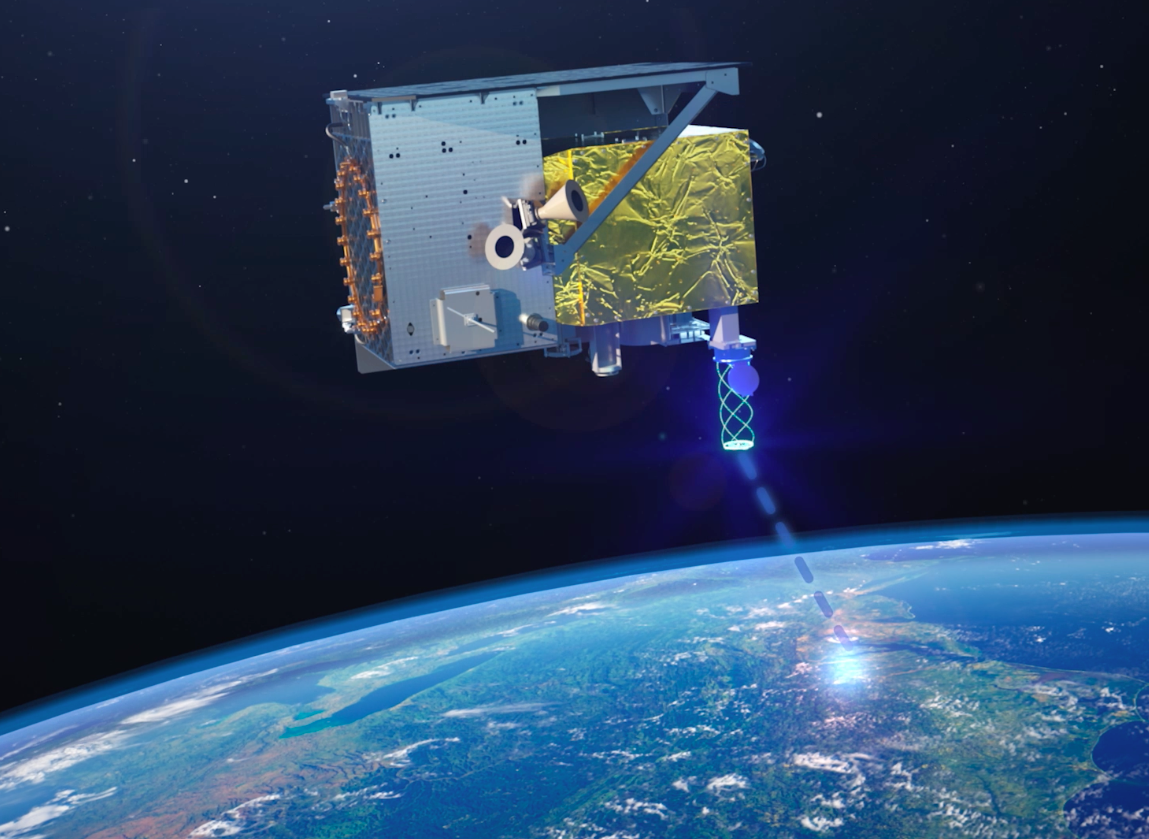
To date, Loft has supported more than 13 AI and software missions for customers like NASA, Microsoft, Helsing, Little Place Labs, and Wallaroo.AI. This includes collaborating with NASA’s Jet Propulsion Laboratory to deploy the first on-orbit visual language model for near real-time Earth observation and object detection. These applications are diverse, ranging from the global tracking of vessel movements to detecting radar jamming. Loft has become the open platform for leading AI companies to meet evolving global challenges in new ways. We are no longer operating like the cloud as a metaphor. Loft is the cloud infrastructure in space supporting rapid, reliable insights.
Constellations as a Service: EarthDaily and Multi-satellite Launches
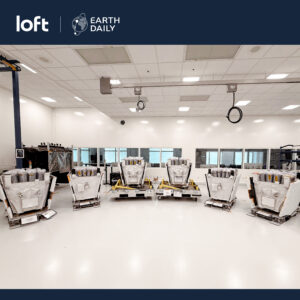
Launching customer payloads on dedicated and rideshare platforms became so routine for Loft, that supporting constellations was the natural next step. We’re integrating, launching, and operating 10 satellites for the EarthDaily Constellation, a system purpose-built to deliver daily, globally consistent measurement of planetary change. As of today, Loft has launched seven satellites on behalf of the company, with another slated to just next week. To support the customer’s timeline, this also led Loft to challenge itself to integrate six satellites on a single launch, and find new ways to automate commissioning operations to stay ahead of schedule. This work with EarthDaily has demonstrated Loft’s ability to deliver not just missions, but scalable systems, with much more to come.
Orbitworks: Opening the Door to Sovereign Space Capacity
One of the most significant milestones in Loft’s story is the opening of Orbitworks, and what is now a proven model for enabling partners and nations to build their own sovereign space capabilities leveraging Loft’s infrastructure and expertise. Orbitworks is a joint venture with Marlan Space, and the first satellite production facility in the Middle East. It represents a maturation of everything Loft has learned in five years and an answer to a common question from our government customers: how do we build a space capability that we actually own and control, without starting from scratch?
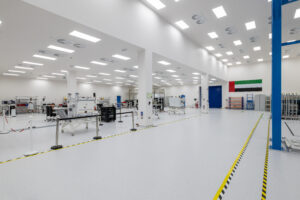
Joint ventures like Orbitworks allow customers to gain access to Loft’s platform, expertise, and on-orbit infrastructure while retaining the security, autonomy, and sovereign capacity that matters to them. Today, Orbitworks is supporting three contracts for the French government to develop Earth observation and AI-driven intelligence missions. The team is also working closely with other customers to deploy novel capabilities like in space quantum encryption. This year Orbitworks will be launching Altair, the first fully AI-enabled, multi-sensing constellation with edge compute and always-on connectivity for near real-time intelligence.
5 Years In and Just Getting Started
In some respects, we have surprised ourselves with how far we have come. YAM-3 validated our new operating model. AI-enabled platforms like YAM-6 expanded the mission profiles. The EarthDaily constellation is proving we can deliver at scale. And Orbitworks has become a blueprint for a future where any nation or organization can have rapid and secure sovereign access to space.
Fast, simple, and reliable has been the standard we’ve held ourselves to as a mission and an operating philosophy, and it’ll carry the company forward the next 5 years into AI infrastructure and constellations as a service. None of this would have been possible without our incredible team of global experts working together to build something new.
#SpaceMadeSimple
Frequently Asked Questions
How many satellites has Loft launched to date?
- To date, Loft has launched 14 satellites. That number is slated to double in 2027.
Have you deployed any AI models on-orbit?
- Loft worked with NASA’s Jet Propulsion Laboratory (JPL) to deploy the first vision language model on-orbit, powered by Google’s Gemma-3 and NVIDIA GPUs. JPL’s software identified areas of interest in response to natural language queries, combining contextual understanding of large language models with the ability to analyze imagery for near real-time Earth observation analysis. Read the paper here.
What other payloads are you flying on orbit? Are they available to other customers?
- Yes! Excluding some customers’ proprietary payloads, Loft offers a suite of hyperspectral, multispectral, RF, and thermal sensors that customers can access on demand or to support their software applications. In addition to a multi-node processing architecture, this model is a core enabler for NASA’s JPL AI software missions.
Who are Loft’s customers?
- Loft works across government, defense, and commercial sectors supporting national space agencies, defense primes, and AI developer partners from around the world. This includes the French Space Agency (CNES), NASA, Lockheed Martin, EarthDaily, Helsing, Microsoft, AWS, BAE Systems, Andruil, and more.
How is Loft supporting space sovereign initiatives?
- Loft currently has three contracts with the French Space Agency (CNES) to support their initiatives to build wholly owned space capabilities. This includes synthetic aperture radar (SAR) imaging capabilities and access to an AI-powered, multi-sensor Earth observation constellation.
- Orbitworks was also built as the first satellite production facilities in the Middle East to support regional and European countries as an alternative to other integration facilities heavily concentrated in the far West and East.
What makes Loft different from other space companies exploring AI in space capabilities.
- Loft isn’t an AI company. We’re building a unique open infrastructure of satellites that allows expert software and AI companies to deploy their own models on orbit. With the coming launch of Altair, a 10+ satellite constellation with always-on connectivity, multi-sensing payloads, and a high-performance processing architecture, Loft is building a marketplace of applications to support diverse use cases. Most other players are exploring future data centers or developing AI capabilities on closed platforms. Loft has one of the only open platforms with technically diverse, proven ecosystem partners like NASA, Microsoft, and Helsing proving software and agentic AI on orbit, today.
Which hardware providers does Loft work with to enable AI in Space?
- Loft Orbital is flying NVIDIA GPUs on multiple satellite programs that allows us to deploy AI applications on NVIDIA chips using NVIDIA compute unified device architecture (CUDA) toolkits. Loft also deploys AI applications using space-hardened CPUs from multiple space hardware providers in Europe and North-America, and multiple field-programmable gate arrays (FPGA) where we have been directly running a deep neural network (DNN).